











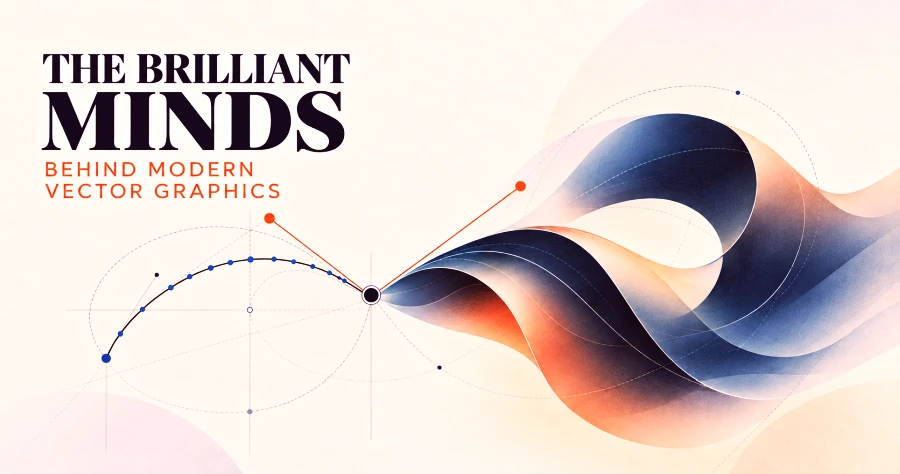
How 1950s French car engineering gave us the curves used in Illustrator, Figma and After Effects.
Every time a designer pulls a curve handle in Illustrator, adjusts a mask in After Effects, or bends a path in Figma, they are using mathematics developed more than sixty years ago — not for digital art, but for shaping cars.
The familiar anchor points and handles of vector software descend from work carried out at two competing French manufacturers. At Citroën, Paul de Casteljau devised an elegant method for calculating smooth curves and surfaces. His research remained largely confidential. At Renault, Pierre Bézier independently developed a related approach, published it, and made it part of a working computer-aided design system.
One man gave us the algorithm. The other gave the curve its name.
Together, their work helped move design from physical templates and hand-shaped models into mathematical descriptions: shapes that could be calculated, reproduced, enlarged, machined, printed, and eventually animated. The journey from a car body to a typeface or motion path is less unlikely than it sounds. In each case, the problem is the same: how do you describe a smooth, controllable curve precisely enough for a machine to reproduce it?
The problem was not drawing a beautiful car
Long before modern CAD, automobile bodies were already designed with great care. Stylists drew sweeping profiles; craftspeople built full-size models; engineers translated those forms into drawings, templates, and tooling.
But a drawing and a manufactured panel are not the same thing.
A car body is a continuous surface. Its highlights must travel cleanly across doors, fenders, and roof panels. A slight irregularity that seems invisible on paper can become painfully obvious when light moves across painted metal. Worse, the intended form has to survive a chain of translations — from the stylist’s model to technical documentation, dies, milling machines, and the production line.
Physical templates could capture cross-sections, but they were cumbersome to store and difficult to revise. A collection of measured points could record a shape, but points alone did not explain what happened between them. Manufacturers needed a numerical language for free-form surfaces: one that gave designers control, gave engineers precision, and gave machines instructions they could follow.
This was not an abstract mathematical puzzle. It was a manufacturing problem with a mathematical answer.
Paul de Casteljau and the curve hidden inside Citroën
Paul de Faget de Casteljau joined Citroën on 1 April 1958, after studying mathematics and physics at the École Normale Supérieure and completing military service. He was twenty-seven years old.
Citroën asked him to help turn the forms created by its designers into numerical information suitable for tooling and machining. Within a year, he had documented the basis of what is now called the de Casteljau algorithm. A 1959 report was deposited by Citroën at France’s intellectual-property office, establishing an early record of the work. By 1963, his notes had extended the approach from curves to surfaces.
At Citroën, these shapes were called courbes à pôles — “curves with poles.” Today we would call those poles control points.
The important idea was that a designer did not need to specify every point on a curve. Instead, a small control polygon could govern the entire shape. Move one of its points and the curve changed smoothly and predictably. The resulting geometry could be calculated at any position and divided into smaller sections without changing its form.
That is essentially what happens when a designer drags a Bézier handle today. The interface conceals the calculation, but the relationship is the same: a few points control a continuous curve.
How the method works — without the equation
Imagine four control points connected by three straight lines.
Choose the same percentage along each line — say, halfway — and mark three new points. Connect those new points, then repeat the process to obtain two more points. Connect those, take the same percentage once again, and the final point lands on the curve.
Change the percentage from zero to one and repeat the construction. The final point traces the complete curve.
See the Pen Interactive de Casteljau Bézier Curve Visualizer by Motiopix.
This repeated interpolation is the de Casteljau algorithm. It is geometrically intuitive, numerically dependable, and useful for both evaluating and subdividing a curve. A modern design application performs the steps invisibly and almost instantly. De Casteljau formulated them when computer graphics barely existed as a field.
He was not creating mathematics from nothing. The polynomial basis associated with these curves had roots in Sergei Bernstein’s work from the early twentieth century. De Casteljau’s achievement was to turn that mathematical foundation into a practical geometric method for designing and manufacturing complex forms.
Citroën’s secret
De Casteljau’s timing was remarkable. So was the obstacle facing him.
Citroën treated the work as industrial knowledge. The method was documented internally and incorporated into the company’s systems, but the company’s secrecy prevented its creator from explaining it openly to the wider technical community. Later historical research notes that Citroën’s approach remained concentrated in a very small group, while comparable work elsewhere was discussed with universities and presented at international conferences.
The result was not that de Casteljau vanished completely. His name now belongs to the algorithm, and specialists in computer-aided geometric design recognize his foundational role. But recognition arrived late. Citroën’s approach began to appear in French technical literature in the 1970s; de Casteljau gained wider international recognition only later in that decade.
By then, another name was already attached to the curve.
There is an appealing temptation to turn this into a story about stolen credit. The history does not support that simple version. Pierre Bézier did not merely rename de Casteljau’s algorithm. Working at Renault, he developed his own geometric construction and pursued a broader ambition: an integrated system in which computers could assist the path from styling through drafting and toolmaking.
The decisive difference was visibility.
Pierre Bézier and Renault’s UNISURF
Pierre Étienne Bézier had joined Renault in 1933 and spent more than four decades at the company. He worked in tooling, production engineering, and automation before turning his attention to the numerical description of automobile bodies.
During the 1960s, Bézier independently arrived at a related way of representing polynomial curves and surfaces through control points. His construction was not identical to de Casteljau’s, particularly in its treatment of surfaces, but both men were solving the same industrial problem and arrived in the same mathematical territory.
Bézier was able to present and publish his ideas. More importantly, he placed them inside UNISURF, Renault’s pioneering CAD/CAM system. UNISURF was not simply a curve-drawing demonstration. It aimed to connect styling, surface definition, technical drawing, and the machining of production tools. By the mid-1970s, it was being used in the French automobile industry.
That practical system gave Bézier’s work a public stage. His name travelled through conferences, papers, and the emerging computer-aided-design community. The polynomial representation became known as the Bézier form; its control points became Bézier points; the curves became Bézier curves.
Meanwhile, the recursive method most commonly used to calculate them retained de Casteljau’s name.
That division of credit is unusually appropriate. Bézier made the curve visible and demonstrated its place in an end-to-end design system. De Casteljau supplied the elegant computational procedure beneath it. Modern vector graphics inherits both legacies.
Why the better-publicized name survived
Names in technology rarely provide a complete map of invention. They tend to follow publication, teaching, products, and communities — the channels through which an idea becomes usable by other people.
Bézier had those channels. He published during the 1960s and presented his research internationally. UNISURF made the theory tangible. A person hearing about the method could connect a name to a curve, a system, and a real industrial application.
De Casteljau had produced his crucial work earlier, but corporate confidentiality interrupted that path. A mathematical idea can exist inside a company and still remain almost absent from the public history of its field.
This does not diminish Bézier. Nor does restoring de Casteljau require replacing one simplified hero story with another. Their achievements were distinct and complementary. Even the mathematics reaches further back than either man. What their story reveals is how invention actually acquires a name: discovery matters, but so do permission, publication, and demonstration.
From car bodies to type
Once a curve can be described mathematically, its scale stops being a fundamental limitation.
The same outline can be rendered a few pixels high on a screen, printed across a poster, or used to guide a machine across a large surface. Instead of storing a separate picture at every size, software stores points and instructions. The final image is calculated when it is needed.
This made Bézier geometry a natural fit for digital typography and page description. Adobe’s PostScript language, introduced in the 1980s, described graphic paths and character outlines with cubic Bézier curves. A printer could receive a mathematical outline, scale it, and rasterize it at the resolution of its output device. PostScript became central to desktop publishing, carrying the geometry of automotive surfaces into letters, logos, and printed pages.
The typographic story contains an important technical footnote. PostScript-style font outlines use cubic Bézier curves, while TrueType outlines use quadratic Bézier curves. Their control structures differ, but they belong to the same family of polynomial curve techniques. In either case, a glyph is not fundamentally a fixed grid of pixels. It is a set of scalable contours.
That shift helped make type behave as modern designers expect: editable, transformable, and independent of a single output size.
From paths to motion
Vector software inherited the same visual grammar.
In Illustrator, anchor points and direction handles shape paths. In Figma, vector networks extend the conventional path model, but curved segments are still manipulated through Bézier handles. In After Effects, Bézier geometry appears in masks and shape paths — and the concept also governs how motion changes over time.
This is where the legacy becomes especially easy to overlook. A curve can describe more than an outline.
In an animation editor, it can describe the route an object follows across the frame. In a graph editor or CSS cubic-bezier() function, a curve describes
the relationship between elapsed time and progress. Pull a handle and an object eases gently into motion, accelerates sharply, or settles slowly at the end.
The same family of mathematics therefore solves two different design problems:
Where should the line or object go? A Bézier curve describes geometry or a motion path.
How should it move? A Bézier curve describes timing and acceleration.
Designers experience both through direct manipulation. They do not calculate Bernstein polynomials or perform recursive interpolation. They pull a handle until the curve looks right or the movement feels right. Decades of interface design have turned difficult mathematics into a visual gesture.
The mathematics beneath the handle
It is easy to treat the Pen tool as a natural feature of a computer, as if digital curves had always come with points and handles. They did not.
Those handles are the visible remains of a specific historical problem: French automobile manufacturers trying to preserve the subtle forms created by stylists while making those forms precise enough for machines. De Casteljau found an exceptionally elegant way to calculate them. Citroën kept that work close. Bézier independently developed and publicized a related representation, then demonstrated its value through Renault’s UNISURF system.
The curve took Bézier’s name. The algorithm kept de Casteljau’s. Their combined legacy escaped the factory and became part of the ordinary language of digital design.
Today it is present in the edge of a logo, the bowl of a typeface, the silhouette of an illustration, the path of an animated object, and the easing between two keyframes. What began as a way to make metal surfaces reproducible became a way to make almost any digital form controllable.
Millions of designers now use that mathematics by eye.
Most never need to know the equation. But the next time a pair of handles emerges from an anchor point, it is worth remembering where it came from: not a software toolbar, but two engineers, two car companies, and two different routes by which an idea entered history.
Further reading and sources
Andreas Müller, “A tour d’horizon of de Casteljau’s work”, Computer Aided Geometric Design (2024).
Andreas Müller, “Paul de Casteljau: The story of my adventure — From an autobiographical letter”, Computer Aided Geometric Design (2024).
Pierre-Jean Laurent, “Pierre Bézier: An engineer and a mathematician”, Computer Aided Geometric Design (2001).
Christophe Rabut, “On Pierre Bézier’s life and motivations”, Computer-Aided Design (2002).
Comments (0)